Feed on
Posts
Comments
URL Listing Directory Submit ExpressSearch Engine Marketing

Glossary

I will update this list continually. All suggestions are welcome.

Chord

A combination of notes played simultaneously.

Key

A key is what you use to unlock something. In playing piano by chords, a key unlocks all the chords that you need for a song.

For instance, the 3 basic chords (I, IV and V chords) in the C key are: C (I), F (IV) and G (V). And if the key were F, then these 3 chords would be: F (I), Bb (IV) and C (V). And of course, being armed with the 3 basic chords, you can also derive the 3 minor chords (II m, III m and VI m), and many other chords in that key.

Octave

Two “doe” notes that are separated by one set of “re”, “me”, “fa”, “so”, “la”, “ti” notes in between.

Scale

A scale simply means a series of notes that comprise the “do”, “re”, “me”, “fa”, “so”, “la”, “ti” notes.

For example, a C major scale is made up of the C, D, E, F, G, A, B notes. That is, when you play these notes one after another in this order: C–D–E–F–G–A–B, you get the do–re–me–fa–so–la–ti sounds. In the same way, an F major scale is made up of F, G, A, Bb, C, D, E notes. That is, when you play F—G—A—Bb—C—D—E, you get the do—re—me—fa—so—la—ti sounds as well, but beginning with the F note.

There are different types of scales, the most common being the major scale and the minor scale. What we have seen above is the major scale. A minor scale differs only slightly from a major scale. The difference is on the 3rd and 6th notes of the scale, i.e., the “me” and the “la” notes. These two notes are flatter in the minor scale than in their corresponding major scale.

For example, a C minor scale is made up of the notes: C, D, Eb, F, G, Ab, B. Similarly, an F minor scale is made up of F, G, Ab, Bb, C, Db, E. Note that when you compare these 2 minor scales with their corresponding major scales above, the 3rd (me) and the 6th (la) notes are flatter (technically speaking, that is referred to as being one “semi-tone” lower).

Transpose

Playing the same song in a different key. It may be a higher or lower key.

Transpose

If you do not have any formal training in piano, you’ll likely find playing songs in any keys other than C difficult. It is tough enough to identify and learn the numerous different chords in one key at the first place, not to mention that there are 12 keys to learn!

Lucky you! There is such a button called “Transpose” on most keyboards and electronic pianos these days. With the use of this button, you can now play in any key. All you have to do is play all the songs in the C key, and let the button does the trick to ‘transpose’ what you play into other keys.

To transpose what you play in the key of C into the key of F, for example, simply choose “F” on your keyboard LCD screen after pressing the ‘Transpose’ button. That is for those of you who have such a screen on your sophisticated keyboard.  J Some keyboards have a transpose setting instead that shows “-6, -5, -4, -3, -2, -1, 0, +1, +2, +3, +4, +5, +6”. The default setting should be “0”. When you switch that setting to +1, then you are transposing what you play 1 step (semi-tone) higher. That means, if you play a C, the resulting sound will be a C#. Similarly, by setting that switch to –1, for example, transpose what you play 1 step (semi-tone) lower, so that playing a C will give you a B sound instead. Therefore, to play a song that is in F key using the transpose key, you need to set your switch to the +5 position.

If the steps to transpose that I have described above are different on your instrument, please check your user manual to find out more.

The 3 Minor Chords

The 3 Minor Chords

Didn’t I say that most songs could be played with just 3 chords? In fact, the 3 basic chords may be “tweaked” a little bit here and there to give us many more other chords! As for now, let’s look at 3 minor chords that can be derived from these 3 basic chords.

We have talked about playing a note or an octave with our left hand in my post called “The Left Hand” earlier. For example, for a C chord on the right hand, we would play a C note or a C octave with the left hand. Now, Let’s tweak this a little…

If you play a C chord with your right hand, and an A note or an A octave instead with the left hand, you will get an A minor7 chord, which sounds pretty much like an A minor chord. This is how we can play a minor chord without having to learn something totally new on our right hand. All you have to remember is that the A note on your left hand must be accompanied with the C chord on the right hand.

Similarly, you can play a D minor by playing a D note with the left hand accompanied by an F chord with your right hand. Playing an E note with your left hand together with a G chord with your right hand will give you an E minor.

Figure 1: A minor (Am)

a-minorjpg

Figure 2: D minor (or Dm)

d-minorjpg

Figure 3: E minor (or Em)

e-minorjpg

So, with that, we have derived the 3 minor chords, Am, Dm and Em from our 3 basic chords.

In the C key, D is the 2nd note (“re”). Therefore, the Dm chord is considered II minor (II m) of C key. E is the 3rd note (“me”) in the C key. Therefore, in the C key, Em chord is the III minor (III m). Similarly, as A is the 6th note (”la”), and therefore Am is considered the VI minor (VI m).

To recap…

VI minor chord (VI m) = 6th bass note (left hand) + 1st chord, I (right hand)

II minor chord (II m) = 2nd bass note (left hand) + 4th chord, IV (right hand)

III minor chord (III m) = 3rd bass note (left hand) + 5th chord, V (right hand)

Deriving the above 3 minor chords (II m, III m and VI m) this way allows us to quickly produce these chords in any key, without having to learn 3 new chords on the right hand. This is provided, of course, that we are familiar with the 3 basic (major) chords (I, IV, and V) of that key.

Inversions

Honestly, you don’t have to know about inversions to play a song. However, being familiar with the different inversions of a chord will be extremely useful for your hand’s movement, from one chord to another.

There are 3 different inversions for a chord. These are called the root position, the 1st inversion and the 2nd inversion.

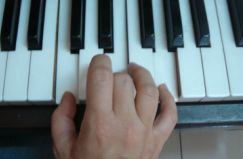
The root position of a C chord is when the “doe”, “me”, and “so” of the C chords are in this order: the “doe” note (1) followed by the “me” note (3) and followed by the “so” note, i.e., 1-3-5 (doe-me-so)

Figures 1: C in the root position

c0jpg

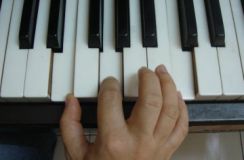
The 1st inversion of a C chord is when the chord is formed with the 3 notes in this order: the “me” note (3) followed by the “so” note (5) and followed by the “doe” (1) note, i.e., 3-5-1 (me-so-doe)

Figure 2: C in the 1st inversion

c1jpg

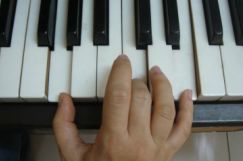
The 2nd inversion of a Chord is when the chord is formed with the 3 notes in this order: the “so” note (5) followed by the “doe” note (1) and followed by the “me” (3) note, i.e., 5-1-3 (so-doe-me)

Figure 3: C in the 2nd inversion

c2jpg

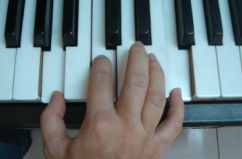
Similarly the 3 inversions for an F chord would look like the following:

Figure 4: F in the root position

f0jpg

Figure 5: F in the 1st inversion

f1jpg

Figure 6: F in the 2nd inversion

f2jpg

Imagine playing a song with the following series of chords: C – F – C – G – C

It would be rather awkward to move your right hand from the root position of the C chord to that of an F chord, for instance. I would play the series like this:

C in the root position…

c0jpg

…followed by F in the 2nd inversion (so that I wouldn’t have to move my thumb)…

f2jpg

… then back to C in it’s root position (again without having to move my thumb)…

c0jpg

… then the G chord in the 1st inversion (so that I wouldn’t have to move my little finger)…

g1jpg

… then return to C again in it’s root position without moving the little finger…

c0jpg

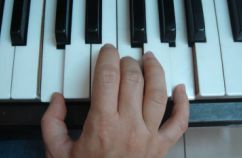
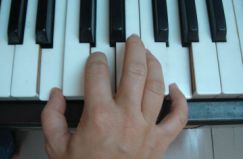
I hope this explains what inversions are and their usefulness. Now, since most songs can be played with the 3 basic chords in a key: I, IV and V chords, you should try to be familiar with the different inversions of these 3 chords. They will be tremendously helpful in playing many other chords within the same key.

The Left Hand

One thing I didn’t mention on “The 3 Basic Chords” post is that, to play a song using chords, usually the chords are played with the right hand, while the left hand plays the “bass” notes.

A question one may ask is, “then with which hand is the melody played?” There are 2 answers to this question. Firstly, you can sing the melody. ;) Secondly, you can play the melody with the right hand also. You will find that after a while, when you are familiar with playing chords and especially the different ways to combine chords, it is indeed much easier to play the melody than if you didn’t know the chords. But that will take time and experience. Let’s leave this till much later.

For the moment, let’s come back to the question about what we should play on the left hand while the right hand is playing a chord. The simplest thing to play on your left hand is just this – one note. Period.

That is, if the chord on the right hand is C, then play the C note on the left hand. Similarly, if the chord on the right hand is an F, then simply play the F note on the left hand. You can choose to play just one note or to play an octave. Put simply, it means 2 “doe” notes that are separated by one set of “re”, “me”, “fa”, “so”, “la”, “ti” notes in between. Figure 1 below shows the C octave. Note that 2 notes are played at the same time, a lower C and a higher C.

Figure 1: C octave

c-octavejpg

Does it matter which lower C and which higher C your left hand should be playing? That’s a good question. In fact, the same question should be asked about the chord on the right hand, i.e., how far on the right of the piano/keyboard should you place your right hand to play a chord? I know this may not sound like a good answer but I can only say “it depends”! It’s a matter of how it sounds to you. It’s like adjusting the treble and bass levels on any of your sound systems, be it a radio, mp3 player, car stereo system, or a home hi-fi. Different people like different settings. So if you find the bass notes you play with the left hand are too “bassy”, then shift your hands further to the right to play higher notes. The same principle applies for the chord on the right hand.

Another thing you can do on your left hand is to play what some call “broken chords”. But I think I will reserve this for another lesson.

So much for now.

« Newer Posts - Older Posts »