Feed on
Posts
Comments
URL Listing Directory Submit ExpressSearch Engine Marketing

Arise

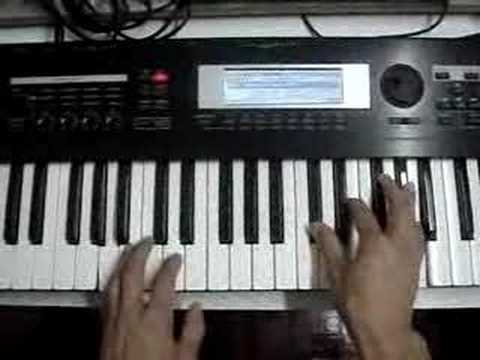
Basically there are 2 parts in this song – the verse and the chorus.

For the verse, the chords progress from Chord I to Chord V, then to Chord –I (minus-one), then to Chord IV. After that, simply repeat this chord progression (I, V, -I, IV) until you reach the chorus.

The chorus has a slightly different progression, i.e., Chord I followed by Chord V, followed by Chord VI m (i.e., VI minor), then Chord IV (I, V, VI m, IV). This pattern is repeated throughout the chorus and until the song goes back to the verse.

The song is in the E key. Therefore, the chords for the verse are E, B, D and A (i.e., E is the Chord I in the E key, B the Chord V in the same key, D the Chord –I, and A the Chord IV). In the video, you would see me play Chord IV (i.e., the A chord in this case) in its 1st inversion, i.e,. C#-E-A notes. The reason is simply to minimize my right hand’s movement.

The chords for the chorus in the E key are E, B, C#m, A.
YouTube Preview Image

If you were to play this in the C key (and use your ‘Transpose’ button to transpose the song to the E key), then the chords are:

Chord I – C

Chord IV – F

Chord V – G

Chord VI m – Am

Chord –I – Bb

That means, you should play C – G – Bb – F (i.e., progression I, V, -I, IV) for the verse, and C – G – Am – F (i.e., progression I, V, VI m, IV) for the chorus.

So, there are only these 2 chord progressions for the entire song. A piece of cake, eh? Have fun!

Share/Save/Bookmark

I have said before that mine is a not-so-conventional theory. That’s one reason why this site is called Piano Cheats at the first place. You probably have not heard and will not hear of any chord called “minus-one” anywhere else.

What exactly do I mean by a minus-one chord. In my definition, it is a chord that is one full tone down from the 1st chord or Chord I. For example, in the key of C, the minus-one chord is the B-flat (Bb) chord. And in the key of G, the minus-one chord is the F chord.

I have no idea and I don’t really care what that chord is called conventionally, but it is easier for me to recognize, identify and locate it on the keyboard by thinking it as one step down (full tone) from Chord I (rather than 6.5 or 7 steps up from Chord I). That’s the reason I call it minus-one. It can’t be Chord Zero, right? If anything should be known as Chord Zero (which usually refers to the baseline in any field), it should be the 1st chord of the key rather than this chord. So, there is no Chord Zero in this theory.

One may ask, “So, in the key of C, the C chord is Chord I, and the Bb chord is Chord –I, what do you call the B Chord?” The answer is, you probably never play a B chord in the C key. So, there is no need to give it a name. (Actually, when you do play a B note as the bass in the C key, you will play a G chord with your right hand. But that is another topic we will cover later.)

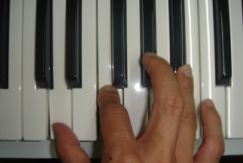
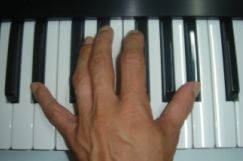
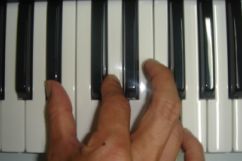
Below are some illustrations of Bb chord (i.e., the minus-one chord, or Chord –I, of the C key):

Figure 1: Bb Chord (root position, i.e., Bb-D-F notes)

bb0jpg

Figure 2: Bb Chord (1st inversion, i.e., D-F-Bb notes)

bb1jpg

Figure 3: Bb Chord (2nd inversion, i.e., F-Bb-D notes)

bb2jpg

And of course, it’s up to you which of the above inversions you prefer depending on which one of them you find easier for you to play.

As for the left hand, just play the Bb note, or a Bb octave as shown below (Note: Just the thumb and the little finger are playing. The other fingers aren’t pressing any key):

bbbassjpg

Technorati

This is just a post for the sake of “claiming” my blog on Technorati site. Not quite sure what benefits I will get from doing this yet. After all, I am a new blogger.

Technorati Profile

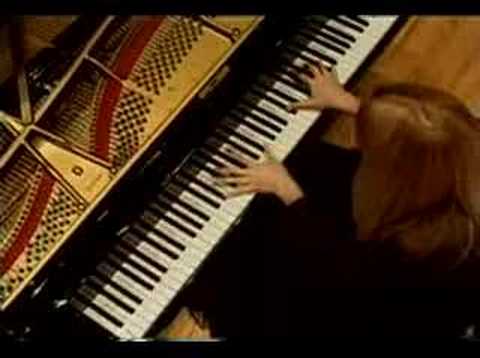
Valentina Lisitsa

Check this out!

I don’t know how to comment… I am speechless! She is simply fantastic!!!

YouTube Preview Image

Fingering

One of the frequently asked questions concerning piano playing is: Which fingers should I use to play the notes?

In Piano Cheats, my answer is: It’s up to you. Really. What matters is how comfortable it is for you by using certain fingers. It should be as natural to you as possible. In formal piano training lessons, one is usually guided to use certain fingers to play certain notes in a piece of music, but these are guides only. They are not rules. If you can achieve all the intended effects of the piece of music — i.e., the sound, the speed, the volume, the consistency, etc. – by playing it YOUR way, even if you were to play with your feet, you have played it right!

« Newer Posts - Older Posts »