Feed on
Posts
Comments
URL Listing Directory Submit ExpressSearch Engine Marketing

Suspension (part 1)

There are 2 types of suspended chords I know. There may actually be more but I only know 2 types. Anyway, you won’t want to learn too many chords playing the cheat way. :)

These 2 types of suspension I know are Sus2 and Sus4. I will come to Sus2 another day, and only explain Sus4 in this post.

When we play a C chord, for example, up till now, we’ve been playing it the “doe-me-so” way. That is, our C chord is made up of the notes C, E and G. They are the 1st, 3rd and 5th notes in the C major scale.

This is how we play a G chord too, just to use another example. Our G chord is made up of G (the “doe” note), B (the “me” note), and D (the “so” note), i.e., the 1st, 3rd and 5th notes of the G major scale. No matter what inversion we may be playing, be it the root position (i.e., 1-3-5), the 1st inversion (i.e., 3-5-1), or the 2nd inversion (i.e., 5-1-3), these three notes (1, 3 and 5) are always there.

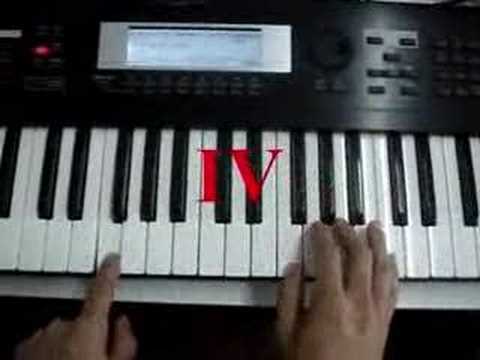
Simply put, a C4 (read “C suspended”, or “C sus-four”, or simply “C-four”) is when you play the 4th note instead of the 3rd note in your chord (together with the other 2 notes: 1st and 5th). That means, a C4 chord would have these notes, 1 (“doe”), 4 (“fa”), and 5 (“so). That is, C4 is when you play C, F and G notes together (compare this with a C chord, when you play C, E and G).

Figure 1: C4

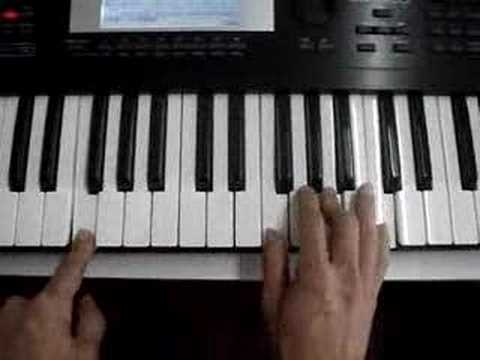
Similarly, a G4 chord is made up of these 3 notes: G (i.e., the “doe” note), C (ie., the “fa” note), and D (i.e., the “so” note). These are the 1st, 4th and 5th notes of the G major scale.

Figure 2: G4

In any key, I know of 2 chords when Sus4 is usually applied. These are the 1st major chord (i.e., Chord I) and the 5th major chord (i.e., Chord V). That means, in the key of C, the only Sus4 chords you need to know are C4 and G4. If you were playing in the key of A, then the only Sus4 chords you would need to know would be A4 and E4 (“A” being the Chord I, and “E” being the Chord V in the A key).

More importantly, when are Sus4 chords used in a song? A suspended chord lives up to its name, i.e., it ‘suspends’ or ‘hangs’ sort-of up there somewhere before coming down to where the song should lead. Take the song “Amazing Grace”, for example. If we were to play this song in the C key, then at the end of the line “… that saves a wretch like me”. The chord on the word “me” may be a G chord (Chord V) straightaway. Another way to play this is to first play G4 (Chord V4), and then play G (Chord V). That means, instead of playing only one G chord at that place, you may choose to play a G4 first, then a G (i.e., 2 chords instead of 1), as a way to enhance the sound.

Another place in the song is “…was blind but now I see”. In the C key, you may just play one chord, i.e., C (Chord I) on the word “see”, or play C4 (Chord I4) first then C (Chord I). You would notice that the music kind-of ‘hangs in the air’ when you are playing C4, and then ‘settles down’ when you ‘resolve’ it with C.

I hope the above is clear. But didn’t we say that most songs can be played with just 3 chords on the right hand? Please check out “Improvising Sus4” under the “Cheat Tricks” category for the answer.

When you can see a pattern in the bass notes, you can then recognize a chord progression (or a pattern of chords) a whole lot easier.

For example, the chords on the right hand in the sample progression in my previous post (“Changing The Bass Notes (part 2)”) may seem rather random, but the bass notes reveal a pattern of walking down the scale, i.e., 1 (doe), 7 (ti), 6 (la), 5 (so), 4 (fa), 3 (me), 2 (re).

In fact, the easier way to recognize a chord pattern is by recognizing the bass note pattern.

To play freely by focussing on bass notes, however, you have to know which chords to accompany each bass note, and be familiar with their association.

Rule number 1: In general, use Chord I to accompany bass note 1 (do), Chord IV to accompany bass note 4 (fa), and Chord V to accompany bass note 5 (so). That’s easy enough. :)

Rule number 2: For the 2 (re), 3 (me), and 6 (la) bass notes, try accompanying them with Chord IV, V, and I respectively. That gives you the 3 minor chords.

Rule #2 applies only when the sound you are to produce is a minor chord, i.e., if you see on your music sheet that the chords are 2nd, 3rd or 6th minor chords. In the key of C, that means, Dm, Em and Am chords.

Rule number 3: If Rule #2 doesn’t apply, then try Chord I for bass note 3 (me), Chord IV for bass note 6 (la), and Chord V for bass note 7 (ti),

Usually such chords are indicated on the music sheet, e.g., in the C key, they would look like C/E, F/A and G/B respectively.

Rule number 4: If applying Rule #3 still does not get you the sound you want, then you are very likely looking for the Major chords of II, III and VI. In the C key, that means D major chord, E major chord, and A major chord, for the 2 (re), 3 (me) and 6 (la) bass notes respectively. Now, that is a bit of a leap for those of us who want to learn piano the cheat way. So, I will cover that much later. Anyway, not to worry, because… (please allow me to repeat)… a lot of songs can be played with just the 3 basic chords. :)

As for now, there are still some tweaking we can do with the 3 basic chords that I should cover first. These include suspension and superimposition, just to sound sophisticated with the names. :) Anyway, to conclude the 3-part series on “Changing The Bass Notes”, let me show you something interesting…

Let’s bring back the progression earlier… (from part 2):

I –> V/7 –> VI m –> I/5 –> IV –> I/3 –> II m –> IV/5

… and tweak it slightly to become this…

I –> V/7 –> VI m –> -I/5 –> IV –> I/3 –> II m –> IV/5

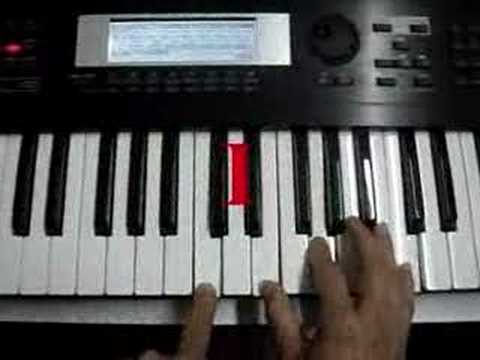
We have tweaked the 4th chord (marked red) in the series above to become Chord –I over the 5th bass note (so). Try playing it. How do you like the sound?

Now try the following shortened version of the above progression with the song “As The Deer”…

I –> V/7 –> VI m –> -I/5 –> IV –> IV/5 –> I

In the key of C, it would look like this:

C –> G/B –> Am –> Bb/G –> F –> F/G –> C

And not to forget the ‘Am’ may be substituted by ‘C/A’ (refer to the theory in ‘The 3 Minor Chords’ post).

Here is the video illustration…

YouTube Preview Image

Note: In the video, my left hand started from a C note that is very near to my right hand. This is solely for the purpose of the video shooting. If I were to play my bass notes one octave lower, then I would have to move the camera further in order to capture both of my hands on the screen. For your own practice, please do play the bass notes one octave lower.

Connie Talbot

Now, a lot of you have probably heard and seen on TV this 7-year-old last year during her competition on Britains Got Talent (she was only 6 at that time).

I am a little bit slow, I admit, and I only got to know about her from a friend today. And my, oh my, her voice can really touch your heart! Anyway, I’m sure you can find out more about her on a lot of sites. Here are a couple of videos of hers to share with you… Don’t miss out!

YouTube Preview Image

YouTube Preview Image

In fact, by combining the 3 basic chords on the right hand with different bass notes on the left hand, you can pretty much get all the chords you need for most songs (not all, of course).

Here is a very common ‘chord progression’ (or a pattern of a series of chords) used in many songs with what-is-commonly-known-as “walking bass notes”. The progression goes like this…

Chord

I

V

I

I

IV

I

IV

V

Bass

1(doe)

7 (ti)

6 (la)

5 (so)

4 (fa)

3 (me)

2 (re)

5 (so)

The “Chord” part is what you play with you right hand. And the “Bass” part is the bass note you play with your left hand to accompany the right-hand chord. The I, IV and V chords are the 3 basic chords (click on the link to go to the post about the 3 basic chords). The ‘numbers’ for the bass notes are the “doe”, “re”, “me”, etc. on the scale.

Another way to present this is:

I –> V/7 –> VI m –> I/5 –> IV –> I/3 –> II m –> V

The way to read a notation like “V/7” above is “Chord V on 7th bass”, i.e., the 5th chord in the key (on the right hand) accompanied by the 7th note (the “ti” note) in the scale (on the left hand).

You would notice from the above that I/6 is in fact VI m (6th minor) chord. Similarly, IV/2 is actually II m (2nd minor) chord. Yes, we have covered that in “The 3 Minor Chords” post previously. You can go back there for revision if necessary.

Let’s tweak the above chord progression slightly to produce a better sound. Remember that F chord and G bass note combination on part 1? This is where it becomes useful. Let’s do that for Chord V (the last chord) in this progression, i.e., let’s substitute V/5 with IV/5. This is what the resulting progression looks like:

I –> V/7 –> VI m –> I/5 –> IV –> I/3 –> II m –> IV/5

Or

Chord

I

V

I

I

IV

I

IV

IV

Bass

1(doe)

7 (ti)

6 (la)

5 (so)

4 (fa)

3 (me)

2 (re)

5 (so)

The part marked red is the only difference (the ‘tweaking’ we are doing).

Below is my illustration on video…

YouTube Preview Image

You probably notice that in the video I play Chord I in its 1st inversion, i.e., in the me-so-doe (3-5-1) position, and Chord V in its 2nd inversion, i.e,. the so-doe-me (5-1-3) position. As I’ve talked about in the “Inversion” post, this is entirely a personal preference. My reason for using those inversions is purely to minimize my hand movement.

Here is a song in which you can make use of this progression. It is a portion of “There Is None Like You” by Don Moen:

YouTube Preview Image

Try that out! Have fun!

Changing The Bass Notes

This is a really useful ‘trick’. Well, at least I think so myself. :)

Most of the time when we play a chord on the right hand, the left hand would accompany that with a bass note (or octave) that corresponds directly to the chord. For example, when you play a C chord with your right hand, you would play a C note with the left hand as the ‘bass’

In fact, by combining the chord on your right hand with a different bass on your left hand can produce some quite interesting sound.

For example, try playing an F chord on your right hand and a G note on your left hand at the same time. How does that sound?

Try it the other way round, i.e., playing a G chord on the right hand accompanied by an F note on your left hand. How do you like that?

I am sure these sounds are quite familiar to you. You have heard them in some songs somewhere. Just when exactly can such combinations be used? I will come to that on another post another day. As for now, I just want to point out that there are various bass notes one can use to accompany a chord to ‘tweak’ the chord and make it interesting.

In ‘The 3 Basic Chords’, we came across the corresponding 3 bass notes for Chord I, IV, and V. These bass notes are ‘do’, ‘fa’ and ‘so’. What else? :)

Then, in ‘The 3 Minor Chords’, we came across 3 more bass notes: ‘re’, ‘me’ and ‘la’. Wait a minute, in fact right there we were already tweaking our Chord I, IV and V into Chord VI m, II m, and III m, simply by combining the 3 basic chords on the right hand with different bass notes on the left hand.

Anyhooser, that leaves us with the ‘ti’ note on the bass that is still not covered yet by any chord. In other words, if you were playing in the key of C, your bass has pretty much covered most of the ‘white’ notes in the C scale, except the B note (i.e., the ‘ti’ in the C scale). However, a couple of questions remain:

- Does the C bass note, for instance, always go with the C chord?, i.e,. Does the ‘do’ note always go with Chord I?

- What about those ‘black’ notes, the sharps and the flats? Will we ever play them?

The answer for the first question is ‘No’, and for the second question is ‘Yes’. I shall go into detail another day.

So much for now.

« Newer Posts - Older Posts »