Feed on
Posts
Comments
URL Listing Directory Submit ExpressSearch Engine Marketing

U.R.Y. by Hillsong

This is how you can play U.R.Y. using 3 fingers – 1 on your left hand, 2 on your right hand. And you need literally only 2 ‘chords’ on your right hand.

There are two parts in this song: the verse and the chorus. Duh.

The progression for the verse actually goes like this (if u r interested, that is. Otherwise, just follow my YouTube video illustration):

VIm –> V –> IV –> I/M –> IV –> V

If this is the first time you see an “M” in a chord notation, check out my “The M Bass” post.

You should immediately notice the bass pattern in the above progression, which goes like this:

6 –> 5 –> 4 –> 3 –> 4 –> 5

The song is in G key, so the chord progression for the verse is translated to:

Em –> D –> C –> G/B –> C –> D

Just keep it this way for the moment. I will come back to this progression again shortly. Let’s turn our attention to the chorus for the moment.

The progression for the chorus goes like this:

I –> VIm –> IV –> V

And in the G key, that means:

G –> Em –> C –> D

So these are the 2 progressions we have got.

Verse: Em –> D –> C –> G/B –> C –> D

Chorus: G –> Em –> C –> D

For those of you who are interested to know how I have turned that into 2 ‘chords’ played with 3 fingers, please read on.

The Em chord here can be an Em7 chord.

The D here is actually a D4 (or Dsus4). Refer to my “Suspension (part 1)” post for Sus4.

The C here is a C2. Refer to “Suspension (part 2)” for Sus2.

What we actually have therefore should be:

Verse: Em7 –> D –> C2 –> G/B –> C2 –> D4

Chorus: G –> Em7 –> C2 –> D4

Now, Em7 can be improvised by G/E (Refer to “The 3 Minor Chords” post). Therefore, the progressions become:

Verse: G/E –> D –> C2 –> G/B –> C2 –> D4

Chorus: G –> G/E –> C2 –> D4

That looks awfully complicated but let’s examine these 3 chords: G, C2 and D4.

G chord is made up of these 3 notes: G, B, D

C2 chord is made up of these 3 notes: C, D, G

D4 chord is made up of these 3 notes: D, G, A

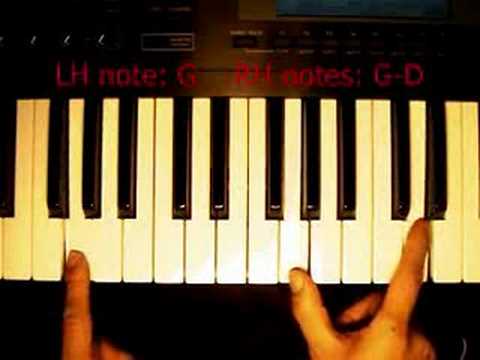
Notice that they all have D note and G note in common? That’s why my right hand can play these 3 chords as 1 ‘chord’ that is made up of 2 notes: D and G (and forget the rest)

The other chord that you see I play on the video is a straight D major chord, which is made up of these 3 notes: D, F# and A. But you must have noticed that I only play the first 2 notes. Well, it’s not a big sin to do so, is it? Afterall, this is ‘Piano Cheats’ here. :)
That D major chord occurs at 2 places: one is in the verse, just after G/E chord. The other place is as a ‘transition’ chord, more of an enhancement to the G chord and the Em7 chord in the chorus. Refer to my “Chord Mixing” post (under “Cheat Tricks” category) for this enhancement trick.

That’s quite enough of the explanation. Here is the video:

YouTube Preview Image

Suspension (part 3)

Remember Sus4? Check out my previous posts on ‘Suspension (part 2)’ and ‘Improvising Sus4’ if necessary. Now, Sus4 is often applied to the II, III and VI major chords, particularly in the ‘Chord Association’ context. Let’s use the following notation for the Sus4 of these 3 chords:

· Let the Sus4 of the II major chord be II4

· Let the Sus4 of the III major chord be III4

· Let the Sus4 of the VI major chord be VI4

The following lists how the II, III and VI major chords associated with other chords from the previous post:

· Chord III –> Chord VIm (i.e., III major chord usually leads to VI minor chord)

· Chord VI –> Chord IIm

· Chord II –> Chord V

Often, however, Sus4 is used before each of the above pairs. For example, Chord III4 –> Chord III/M –> Chord VIm. In the key of C, that means:

· Esus4 –> E/G# –> Am

(That is because Esus4 is the III4 chord in the C key, G# is the M bass of E major chord, and A minor is the VIm chord in the C key)

Therefore you will often encounter such progressions as below in a lot of songs:

· III4 –> III/M –> VIm

· VI4 –> VI/M –> IIm

· II4 –> II/M –> V

Let’s go back to the examples in C. In the C key, the above progressions are translated as:

· Esus4 –> E/G# –> Am

· Asus4 –> A/C# –> Dm

· Dsus4 –> D/F# –> G

I will illustrate this using a song (and to include a video) on my next post. The following shows how to play E4, A4 and D4:

Figure 1: Esus4

e4jpg

Figure 2: Asus4

a4jpg

Figure 3: Dsus4

d4jpg

Let’s recap the chords in ‘Chord Association (part 1)’ post:

· Chord IIIm usually leads to Chord VIm

· Chord VIm usually leads to Chord IIm

· Chord IIm usually leads to Chord V

· Chord V usually leads to Chord I

· Chord I usually leads to Chord IV

The following are often associated with one another in the same way (You will see from here the reason to be familiar with II, III, and VI major chords):

· Chord III usually leads to Chord VIm

· Chord VI usually leads to Chord IIm

· Chord II usually leads to Chord V

In the key of C, that means:

· E usually leads to Am (i.e., E –> Am)

· A usually leads to Dm (i.e., A –> Dm)

· D usually leads to G (i.e., D –> G)

Before I proceed with video illustration of these associations, let’s revisit Suspension (Sus4).

There are 5 parts in this song.

First, the intro, which is the same as the verse, is made up of the following progression:

IIm –> (I/3) –> (V) –> VIm –> (V/7) –> I –> (VI/M)

The chords in brackets ( ) are transition chords, i.e., they are very short. In this case, they appear on the 4th beat of a bar. For example, Chord IIm is played 3 times, then Chord I/3 is played once (together they make up 4 counts of a bar), before move on to Chord IV (the next bar).

An important thing you should take note of in the above progression is the way that the bass notes progress, i.e., they go like this…

2 –> (3) –> 4 –> (5) –> 6 –> (7) –> 1 –> (1#)

The above chord progression repeats itself until the song reaches the pre-chorus which goes like this:

IIm –> I/3 –> IV –> V

Then the chorus goes like this:

IIm –> V –> IIIm –> IV

The pattern repeats itself throughout the chorus until the last line. The ending goes like this…

IIm –> I/3 –> VIm –> II/M –> IV –> V

There is also a bridge that goes like this…

VIm –> IIIm –> IV –> V

Th progression for the bridge repeats until the song returns to the chorus.

This song is in the key of F. So, the 5 different types of chord progressions above are translated as the following:

Intro/Verse: Gm –> (F/A) –> Bb –> (C) –> Dm –> (C/E) –> F –> (D/F#)

Pre-chorus: Gm –> F/A –> Bb –> C

Chorus: Gm –> C –> Am –> Bb

Ending: Gm –> F/A –> Dm –> G/B –> Bb –> C

Bridge: Dm –> Am –> Bb –> C

Take note of the way the bass notes move, especially in the intro/verse and pre-chorus. Can you see a clear pattern there?

I have said earlier that when II, III and V major chords appear in a song, they often do so with their ‘M basses’. For this song, D/F# is the VI major chord with its M bass (F# being the middle note of the D major triad), and G/B is the II major chord with its M bass (B being the middle note of the G major triad).

Here is the illustration on video…

YouTube Preview Image

Notice that my right hand doesn’t need to move much. That’s the beauty of improvising the 3 minor chords using the 3 basic chords! :)

Share/Save/Bookmark

The M Bass

There is no such chord as an M Chord. The ‘M’ here actually stands for “the middle note”. And it’s not new. In fact, we have used that before in Chord I, IV and V. Let’s see:

The middle note of a C major chord is the E note, because the E note is the middle note of the C-E-G triad. Therefore E is the ‘M bass’ of the C major chord. On a chord chart, it’s usually written as C/E (read ‘C on E’).

Similarly, F/A is F major on its M bass, or F/M in my own notation. You probably don’t see this notation anywhere else. But I have a reason to use this notation. We will talk about this later.

G/B (read ‘G on B’) is therefore G/M in my notation.

C, F and G major chords are Chord I, IV and V of the C key.

Now, let’s go back to the II, III and VI major chords (my last post). What I want to tell you is: these 3 chords are usually played with their middle basses.

Back to the example in the C key…

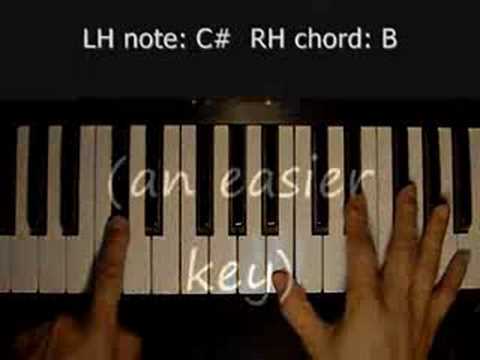
D major chord (i.e., Chord II) is often (though not always) played as D/F#, i.e., D major on the right hand, and F# (i.e., its M bass) note on the left hand.

Similarly, E major (i.e., Chord III) is often played as E/G# (G# being the middle bass note of the E major triad), and A major (i.e., Chord VI) as A/C# (C# being the middle note of the A major triad).

Learn this well. II, III, VI major chords, each on its ‘M bass’, will be very useful. Believe me.

When you are familiar with these 3 chords and their associated M basses, you won’t be troubled by the apparently complicated chords on your music sheets or chord charts when such monsters appear: F/A, E/G#, G/B, D/F#, B/D#, etc. :)

I am going to illustrate the above using “Love Song” by Sara Bareilles. Watch out for my next post.

« Newer Posts - Older Posts »