Feed on
Posts
Comments
URL Listing Directory Submit ExpressSearch Engine Marketing

The 2 different chord progressions in this song are quite obvious. So, without having to say where these 2 are used (you should be able to tell by listening to the song), I will show my video here to illustrate the 2 progressions:

YouTube Preview Image

Progression 1 goes like this:

I –> I/7b –> IV –> IVm/M

See “The M Bass” post for the “M” notation above

Since the song is in D, the above is translated into:

D –> D/C –> G –> Gm/Bb

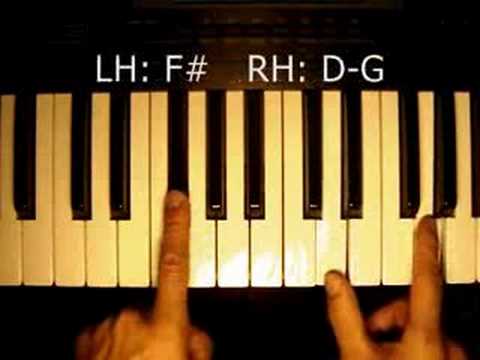
To simplify the playing, I only use 2 fingers on the right hand. So, for the first two chords, all I have to play on the right hand are A note and D note. For the last two chords, I just play G note and D note since these 2 notes are common for both G and Gm chords.

Progression 2 goes like this:

IIm –> I/M –> IV –> V

In the key of D, the above is translated into:

Em –> D/F# –> G –> A

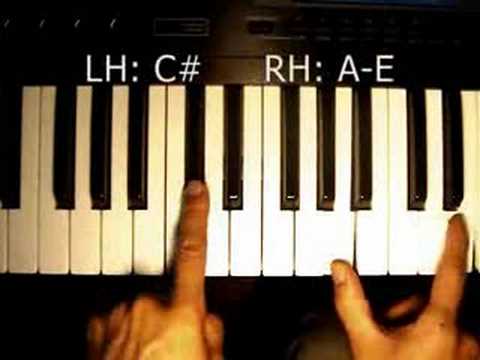
Again to simplify the playing, and to sound like the original track, I actually played Em6 and D2 for the first two chords, and their common notes are A note and E note.

The G chord is played as G and G2 alternately, i.e., G –> G2 –> G –> G2 for the four counts. The same goes for A, i.e., it is played as A –> A2 –> A –> A2 for the four counts. For all these chords, I omitted their last notes, i.e., the D note from the G & G2 chords, and the E note from the A and A2 chords are dropped. There is no particular reason. I just wanted to show how this song could be played using 2 fingers on the right hand. :)

Cry by Rihanna

There are 3 parts in this song… the verse, chorus and the bridge.

The intro is just the first 2 lines of the verse. It goes like this:

Cm –> Ab/C –> Bb/C

These are the notes on the left and right hands:

Chord

Left hand notes

Right hand notes

Cm

C –> G

C –> G –> Eb –> D

Ab/C and Bb/C

C –> Ab

C –> D –> F –> Eb

This is repeated twice.

The rest of the verse goes like this:

AbM7 –> Bb –> Gm7 –> Fm7

These are the notes on the left and right hands:

Chord

Left hand notes

Right hand notes

AbM7

Ab –> Eb

C –> G –> Eb –> D

Bb

Bb –> F

C –> D –> Eb –> Bb

Gm7

G –> D

Bb –> F –> D –> C

Fm7

F –> C

Bb –> C –> D –> C

This progression is played twice too.

Then the chorus goes like this:

Cm –> AbM7 –> Fm7 –> Bb

These are the notes on the left and right hands:

Chord

Left hand notes

Right hand notes

Cm

C –> G

C –> G –> Eb –> C

AbM7

Ab –> Eb

C –> D –> Eb –> C

Fm7

F –> C

C –> G –> Eb –> D

Bb

Bb –> F

Bb –> C –> D –> C

It ends with a Cm.

There is also a bridge, which goes like this:

Cm –> Fm7 –> Gm7 –> AbM7 –> Bb –> Cm –> Bb/D –> Eb –> Ab –> Bb –> Cm

Now, that may look very complicated, but if you know that the key is Eb, then the bass notes’ pattern should be obvious, i.e.,

6 –> 2 –> 3 –> 4 –> 5 –> 6 –> 7 –> 1 –> 4 –> 5 –> 6

Note that the bass notes simply climb up the scale from “re” (2) all the way to “do” (1), before going to “fa” (4), “so” (5) and “la” (6).

The minor chords can be improvised using the 3 basic major chords. See “The 3 Minor Chords” post to find out about improvisation.

That’s all. And here’s the video illustration…

YouTube Preview Image

Share/Save/Bookmark

Matt Harding

Talk about being well traveled? Man! I totally am envious of this guy!!!

Video 1 - Where The Hell Is Matt (2008)?

YouTube Preview Image

Video 2 - Where in Google Earth is Matt?

YouTube Preview Image

Video 3 - Where the hell is Matt?

YouTube Preview Image

There are more. Check out his site www.wherethehellismatt.com

1 May 2013

This is the 3-finger version of the video:
YouTube Preview Image

These are the “cheat” chords I played…
Part 1a: A2 - C#m7 - F#m7 - C#m7
Part 1b: D2 - E/D - C#m7 - F#m7
Part 1c: Bm7 - E11 - E
Part 2a: A2 - E/G# - F#m7 - C#m7
Part 2b: D2 - E/D - C#m7 - F#m7
Part 2c(i): Bm7 - E11 - E
Part 2c(ii): Bm7 - E11 - E - A2

………………………………………………………

25 June 2008

I promised to do a video illustration of Chord Association. Here is one with a very common progression. This is a song by J.J. Lim called Love & Hope.

The intro, verse, and chorus all use the same chord progression in this song. The progression is as follow:

I –> V/7 –> VIm –> IIIm –> IV –> V –> IIIm –> VIm –> IIm –> V

The accompanying bass note pattern goes like this

1 –> 7 –> 6 –> 3 –> 4 –> 5 –> 3 –> 6 –> 2 –> 5 –> 1.

That may look complicated, but if you break it down into parts. They are:

Part 1: 1 –> 7 –> 6 –> 3 (Just going down the scale, in other words, except that it goes to “3” instead of “5” after the “6” (la) note)

Part 2: 4 –> 5 –> 3 –> 6 (Now, this is a very common progression. Just remember it)

Part 3: 2 –> 5 –> 1 (This is another very common progression for ending)

In fact, part 2 & 3 combined makes a very common progression itself, which is:

4 –> 5 –> 3 –> 6 –> 2 –> 5 –> 1

Notice the “Chord Association” we learned before? Note the transition from IIIm to VIm in the progression? And then there is also the transition from VIm to IIm, and also from IIm to V, and lastly from V to I.

This song is done in the key of A, so the above full progression is translated to:

A –> E/G# –> F#m –> C#m –> D –> E –> C#m –> F#m –> Bm –> E

To create more interesting sounds, however, the actual progression played in this song becomes:

A2 –> E4/G# –> A2/F# –> C#m –> DM7 –> E/D –> C#m7 –> F#m –> Bm7 –> D/E –> E

Refer my previous posts (Suspension – part 1 & part 2) for Sus2 and Sus4 chords.

As for the minor-7 (C#m7, Bm7) chords, refer to “The 3 Minor Chords” post to see the improvisation using major chords. Find out from there how you can actually play simple major chords without having to learn those monstrous looking minor-7 chords.

The “E/D” and “D/E” in the progression above are simply “decorative”. If you are not comfortable with them, just play “E” for both.

As for DM7 (read “D Major 7”), I will cover it one day. For now, just play these notes for the chord: D-F#-A-C#. Again, if you aren’t comfortable with this chord, just play “D” instead.

Here is the video illustration…

YouTube Preview Image

I am posting this video to show a reader-friend (who is now learning this song) how I would play the song my “cheat” way.

I have chosen to begin from the middle section of the song (i.e., not from the beginning), as that’s where you can hear the verse, chorus and the bridge one after another.

The progression for the verse goes like this:

IM7 –> I6 –> I –> I6 –> IIIm –> IIm –> V

The song is actually in C#, but I am illustrating it in C in the video, as that is the key most of us would rather play. Translated to C, the above progression looks like this:

CM7 –> C6 –> C –> C6 –> Em –> Dm –> G

Now, such monsters as CM7 and C6 have not yet been discussed on my blog but we will come to that one day. For the purpose of this song, just follow the video. Very quickly, for CM7, you play C-E-G-B notes; and for C6, you play C-E-A notes (watch my right hand in the video).

You would notice that I play Em7 and Dm7 instead of Em and Dm. As we have learned in “The 3 Minor Chords” post, you can improvise Em7 with G/E and Dm7 with F/D.

The progression for the chorus is as follows:

I –> I/M –> IV –> V –> (IV/M) –> (V/M) –> I

In the C key, that is translated to:

C –> C/E –> F –> G –> (F/A) –> (G/B) –> C

The chords in brackets “( )” above are transition chords, i.e., they are played very quickly to transit to the next main chord. You have probably noticed in the video also that the same transition chords are actually used at the end of the verse just before we enter the chorus, and also the end of each chorus progression. The transition is this:

G –> F/A –> G/B

For the “M” bass, please refer to my “The M Bass” post.

For the bridge, the progression goes like this:

IV –> IVm6/2 –> IIIm –> II/M –> IVM7/5 –> V

In the C key, that means:

F –> Fm6/D –> Em –> D/F# –> FM7/G –> G

Now, there are probably a host of questions about the chords above. I won’t go into explaining them for now, as I will cover them in future posts. But for the sake of this song, quickly, this is how you play some of them: For Fm6, play F-Ab-D notes; and for FM7, play F-A-C-E notes.

I know the above probably sounds rather complicated. But if you take note of the bass notes, there are certain patterns in them. Anyway, for now, perhaps it’s easiest to just follow the video. :) Here you go:

YouTube Preview Image

« Newer Posts - Older Posts »