Feed on
Posts
Comments
URL Listing Directory Submit ExpressSearch Engine Marketing

I have also simplified this as much as possible so that one needs only use some simple chords on the right hand to play this song. Btw, this is one of the theme songs for Beijing Olympics 2008.

Here is the video illustration…
YouTube Preview Image

First, let’s go to the verse (which is played twice). The progression goes like this…

1st line: I –> IIm7 –> I/3 –> IV –> IV/5

2nd line: I –> IIm7 –> I/3

3rd line: IV –> I/3 –> IIm7 –> I –> IV/7b –> IV/5

The song is actually in C#. To make it easier to learn and to play, I have transposed it down to C. So, in the key of C, the above 3 lines in the verse are translated into…

1st line: C –> Dm7 –> C/E –> F –> F/G

2nd line: C –> Dm7 –> C/E

3rd line: F –> C/E –> Dm7 –> C –> F/Bb –> F/G

The Dm7 can of course be played as F/D (See “The 3 Minor Chords” post to find out how that is possible), i.e., F chord (right hand) with a D bass note (left hand). Therefore, the above 3 lines are made up completely of 2 chords: C chord and F chord on the right hand.

The bass notes’ patterns should be obvious above, i.e., in the 1st line and 2nd line, the bass notes climb up the scale, whereas in the 3rd line, it climbs down.

The chorus also has 3 lines. This is how they go…

1st line: I –> V/7 –> VIm7

2nd line: VIm7 –> VIm7/5 –> VIm7/4

3rd line: VIm7 –> IVm6/6b –> I/5 –> II/4# –> IV –> IV/5 –> I

In the C key, these are translated into:

1st line: C –> G/B –> Am7

2nd line: Am7 –> Am7/G –> Am7/F

3rd line: Am7 –> Fm6/Ab –> C/G –> D/F# –> F –> F/G –> C

Again, from “The 3 Minor Chords” post, we know that Am7 can be improvised by C/A, i.e., C chord (right hand) with an A bass note (left hand). So, for the first 2 lines, all that you need are 2 chords: C chord and G chord.

For the 3rd line, however, there are Fm6 and D chords to take care of. To simplify matter, do this:

- For Fm6 chord, on the right hand, just play D note and F note, when your left hand plays Ab note.

- And for D chord, on the right hand, just play D note and A note, when you left hand plays F# note.

I hope that is simple enough.
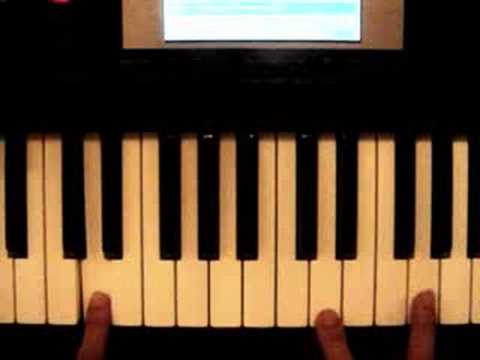
Amazing Grace

The following video illustrates how this song can be played with 3 fingers, while one sings along. The whole purpose is to make it easy to play for adult learners especially.

YouTube Preview Image

I used only one finger for the bass (left hand), mainly because that way, it’s easier to fit into the camera view. It would sound better if you were to play an octave instead.

By following the video, you should be able to play the song and sing along even if you haven’t played any piano before.

However, for those who are interested to know how I arrived at 3 chords, or 3 fingers, please read on…

Basically, the 2 chord progressions go like this…

I –> -I/1 –> IV –> I/3 –> VIm –> II/M –> V

Followed by…

I –> -I/1 –> IV –> I/3 –> IIm –> V –> I

Please refer to “The M Bass” post for the “M” notation, and “The Minus-One Chord” post for the “-1″ notation.

In the key of G, the first progression is translated into:

G –> F/G –> C –> G/B –> Em –> A/C# –> D

What I actually played however, with a little bit of tweaking here and there is…

G –> F/G –> C2 –> G/B –> Em7 –> A/C# –> C2/D

If you don’t know what a C2 is, please refer to my earlier “Suspension” post.

As for the second progression, in the key of G, it is translated into:

G –> F/G –> C –> G/B –> Am –> D –> G

Again, with a little bit of tweaking, what I actually played is…

G –> F/G –> C2 –> G/B –> C2/A –> C2/D –> G

Please refer to “The 3 Minor Chords” post to see how ‘Am’ can be improvised by ‘C/A’.

After the tweaking, you would notice that the chords for right hand are left with G, F, C2, Em7 and A.

Therefore on the right hand, this is what I played:

For G, C2 and Em7 chords, I played the 2 common notes: D and G

For F chord, I played C and F notes.

And for A chord, I played E and A notes.

Thus the resulting 3 “chords” with 2 notes each.

You may use any two fingers you like for the two notes on the right hand. The reason I used the Index and Middle fingers in the video is just for the purpose of showing more distinctively which notes I actually pressed.

That’s all.

Mandy by Barry Manilow

I have done this song the “cheat” way — in the C key and using only the 3 basic chords (on the right hand). I hope a beginner, especially an adult beginner, will find this easy to follow.

The progression for the verse goes like this (played twice):
C –> G/C –> F/D –> F/C –> F/Bb –> F/G

That means your right hand plays: C, G, F, F, F, F in that order.

And your left hand plays: C, C, D, C, Bb, G in that order.

The alphabet to the right of (or under) the “/” sign means the bass note. When it is not there, you just place the same note as the chord symbol.

For example, when you see a “C”. Play C chord on the right hand, and the C note on the left hand. But if you see “C/A”, that means you should play C chord on the right hand, with the A note on the left hand.

The chorus goes like this (also played twice):

C –> C/A –> C/F –> G –> F/G –>G –> C

You will note that in the video, I played the F chord in its root position, but for the G chord, I used the 2nd inversion, and for the C chord, I used the 1st inversion. The different positions/inversions simply make it easier to change chords, without having to move my right hand too much. See my “Inversions” post if you need help with understanding inversions.

Here is the video illustration…

YouTube Preview Image

The 2 different chord progressions in this song are quite obvious. So, without having to say where these 2 are used (you should be able to tell by listening to the song), I will show my video here to illustrate the 2 progressions:

YouTube Preview Image

Progression 1 goes like this:

I –> I/7b –> IV –> IVm/M

See “The M Bass” post for the “M” notation above

Since the song is in D, the above is translated into:

D –> D/C –> G –> Gm/Bb

To simplify the playing, I only use 2 fingers on the right hand. So, for the first two chords, all I have to play on the right hand are A note and D note. For the last two chords, I just play G note and D note since these 2 notes are common for both G and Gm chords.

Progression 2 goes like this:

IIm –> I/M –> IV –> V

In the key of D, the above is translated into:

Em –> D/F# –> G –> A

Again to simplify the playing, and to sound like the original track, I actually played Em6 and D2 for the first two chords, and their common notes are A note and E note.

The G chord is played as G and G2 alternately, i.e., G –> G2 –> G –> G2 for the four counts. The same goes for A, i.e., it is played as A –> A2 –> A –> A2 for the four counts. For all these chords, I omitted their last notes, i.e., the D note from the G & G2 chords, and the E note from the A and A2 chords are dropped. There is no particular reason. I just wanted to show how this song could be played using 2 fingers on the right hand. :)

Cry by Rihanna

There are 3 parts in this song… the verse, chorus and the bridge.

The intro is just the first 2 lines of the verse. It goes like this:

Cm –> Ab/C –> Bb/C

These are the notes on the left and right hands:

Chord

Left hand notes

Right hand notes

Cm

C –> G

C –> G –> Eb –> D

Ab/C and Bb/C

C –> Ab

C –> D –> F –> Eb

This is repeated twice.

The rest of the verse goes like this:

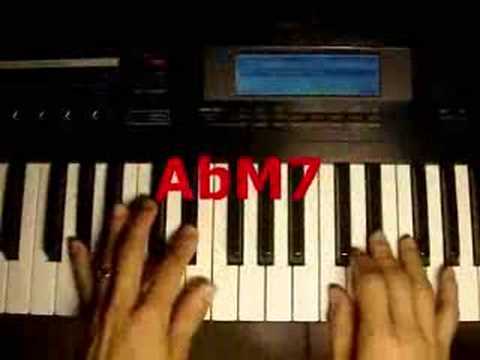
AbM7 –> Bb –> Gm7 –> Fm7

These are the notes on the left and right hands:

Chord

Left hand notes

Right hand notes

AbM7

Ab –> Eb

C –> G –> Eb –> D

Bb

Bb –> F

C –> D –> Eb –> Bb

Gm7

G –> D

Bb –> F –> D –> C

Fm7

F –> C

Bb –> C –> D –> C

This progression is played twice too.

Then the chorus goes like this:

Cm –> AbM7 –> Fm7 –> Bb

These are the notes on the left and right hands:

Chord

Left hand notes

Right hand notes

Cm

C –> G

C –> G –> Eb –> C

AbM7

Ab –> Eb

C –> D –> Eb –> C

Fm7

F –> C

C –> G –> Eb –> D

Bb

Bb –> F

Bb –> C –> D –> C

It ends with a Cm.

There is also a bridge, which goes like this:

Cm –> Fm7 –> Gm7 –> AbM7 –> Bb –> Cm –> Bb/D –> Eb –> Ab –> Bb –> Cm

Now, that may look very complicated, but if you know that the key is Eb, then the bass notes’ pattern should be obvious, i.e.,

6 –> 2 –> 3 –> 4 –> 5 –> 6 –> 7 –> 1 –> 4 –> 5 –> 6

Note that the bass notes simply climb up the scale from “re” (2) all the way to “do” (1), before going to “fa” (4), “so” (5) and “la” (6).

The minor chords can be improvised using the 3 basic major chords. See “The 3 Minor Chords” post to find out about improvisation.

That’s all. And here’s the video illustration…

YouTube Preview Image

Share/Save/Bookmark

« Newer Posts - Older Posts »