Amazing Grace
Jul 8th, 2008 by admin
The following video illustrates how this song can be played with 3 fingers, while one sings along. The whole purpose is to make it easy to play for adult learners especially.
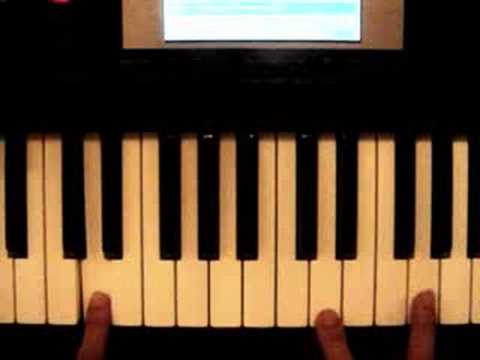
I used only one finger for the bass (left hand), mainly because that way, it’s easier to fit into the camera view. It would sound better if you were to play an octave instead.
By following the video, you should be able to play the song and sing along even if you haven’t played any piano before.
However, for those who are interested to know how I arrived at 3 chords, or 3 fingers, please read on…
Basically, the 2 chord progressions go like this…
I –> -I/1 –> IV –> I/3 –> VIm –> II/M –> V
Followed by…
I –> -I/1 –> IV –> I/3 –> IIm –> V –> I
Please refer to “The M Bass” post for the “M” notation, and “The Minus-One Chord” post for the “-1″ notation.
In the key of G, the first progression is translated into:
G –> F/G –> C –> G/B –> Em –> A/C# –> D
What I actually played however, with a little bit of tweaking here and there is…
G –> F/G –> C2 –> G/B –> Em7 –> A/C# –> C2/D
If you don’t know what a C2 is, please refer to my earlier “Suspension” post.
As for the second progression, in the key of G, it is translated into:
G –> F/G –> C –> G/B –> Am –> D –> G
Again, with a little bit of tweaking, what I actually played is…
G –> F/G –> C2 –> G/B –> C2/A –> C2/D –> G
Please refer to “The 3 Minor Chords” post to see how ‘Am’ can be improvised by ‘C/A’.
After the tweaking, you would notice that the chords for right hand are left with G, F, C2, Em7 and A.
Therefore on the right hand, this is what I played:
For G, C2 and Em7 chords, I played the 2 common notes: D and G
For F chord, I played C and F notes.
And for A chord, I played E and A notes.
Thus the resulting 3 “chords” with 2 notes each.
You may use any two fingers you like for the two notes on the right hand. The reason I used the Index and Middle fingers in the video is just for the purpose of showing more distinctively which notes I actually pressed.
That’s all.



Hi Leshymes
I decided to come back to watch your videos. But I try to read your explanations and I find it very difficult to follow because my computer shows all your brackets like this:
it contais all the brackets saying if !supportEmptyParas] and [endif] etc. I don’t know what they are.
G –> F/G –> C –> G/B –> Am –> D –> G
The above chord progression when I cut and paste here, it looks normal. But on my screen where you have the arrow sign it shows a twirly symbol in between all of them and hard to follow.
I wonder if it is my computer setting or what and that makes it hard for me to follow the explanation.
So far I only watched a couple of your videos but can’t follow the explanations because all these brackets and funny symbols.
think you might know what is the cause?
Hi Pianogal,
Yes, I am aware of that “phenomena” when viewing on Microsoft IE (Internet Explorer). Do you have a different browser, like Mozilla Firefox, or Netscape, or Safari? Apparently, this happens only on IE. I have yet to find a solution to this, but it can be solved simply by viewing on a different browser.
I have just done some work to get rid of as many of the “strange symbols” as possible. I hope it looks better now. I had to go into my posts one by one, copied out the contents from Wordpress, pasted them onto a simple Notepad, then copied and pasted them back into Wordpress. I have minimized the symbols though didn’t manage to get rid of all of them.
Ley Hymes, I forgot where I posted this for you.
I am using firefox and no problem. Now I am motivated to study your videos and the description.
For the longest time, I could not figure out what you were saying with those strange symbols.
That’s great!
I came in to try to see your video on Amazing Grace but it says, sorry the video is no longer available.

Hi,
I have just tried playing the video, both on the blog (this page), and also on YouTube. It is there.
Perhaps there was something with YouTube at the time you tried playing it? Please try again.
Les
I managed to see it today so it is ok.
I made a midi for you to listen, please click to this link:
http://www.box.net/shared/v31upy51ub
I did this in C.
I followed our tweak:
I –> -I/1 –> IV2 –> I/3 –> VIm –> II/3 –> IV2/V
I–> -I/1 –> IV2 –> I/3 –> IV2/ii –> IV2/V –> I
Your original is:
I –> -I/1 –> IV –> I/3 –> VIm –> II/M –> V
I –> -I/1 –> IV –> I/3 –> IIm –> V –> I
Is it that you want to say that IV2/V is the same as V
and
IV2/ii and IV2/V is the same as ii V ?
Just wondering if I am approaching this as you would like us to approach.
The idea is to hit different bases but keep the basic major chords intact for the right hand?
And then for the D, you hit a F# bass?
Hitting the F# bass will make the chord become what chord?
I think you are using the bass line following the Circle of 5th of Em to Am to D to G to C?
yes, no?
Can you let me know if this is the way I should play it with your chords symbols? I want to play the melody line into it and not just accompaniment.
By comparison, I noticed that your progression applies Sus2 to Chord IV, and you have made use of IV/5 that I talked about in “Changing The Bass Notes”.
Yes, IV/5 can be used to replace Chord V most of the time, especially before going back to Chord I. But I usually use IV rather than IV2. I guess it’s ok to use IV2. I have listened to your track, and it sounds alright. It’s a personal preference I guess. Similarly for IIm, I usually play it as a IIm7, which in my theory is translated into IV/2. I noticed that you used IV2/2 instead.
Yes, for Chord II (the D chord), the “M” bass is F# note. But in my notation, I would not call it II/3, because “3″ here refers to the “mi” note of the C key, which is the “E” note. So, it may be more correct to call it II/4#.
The resulting chord is simply called D/F#.
Regarding the ‘circle of fifth’ for the bass line, if you were referring to the 1st progression, then yes, since it goes from E to A to D to G then to C. However, one may use the F# bass instead of D for the D chord.
I think you are on the right track.
By getting the chords right on your right hand, you can also play the melody line more easily.
I used IV2 because I saw you using this for G key:
—–
Again, with a little bit of tweaking, what I actually played is…
G –> F/G –> C2 –> G/B –> C2/A –> C2/D –> G
——-
So I transferred tht to IV2 (a 9th in there)
To get the 2 minor7 chord — I do IV/II, right?
Thanks for clarifying the ‘M” — I tried to figure out all afternoon today wht that M meant and thought it was a typo. LOL!!!! I know what you are saying.
So when you hit the F# before the D –> is it to create the nice bassline to go from half step from F# to G rather than the normal D to G?
Your last sentence:
——————–
By getting the chords right on your right hand, you can also play the melody line more easily.
———————
Do you mean for the RH, I only think in hitting the basic chords C F & G with their inversions to fit the melody?
Sometimes I use IV2 instead of IV. I do that quite often too for Chord I, i.e., using I2 instead of I.
Yes, for IIm7, do a Chord IV on the “2″ bass. I would call that IV/2, rather than IV/II, as I use the “I, II, III…” symbols for chords, and “1, 2, 3…” symbols for notes in the scale of the key for the song (as in “doe, re, mi…”).
Yes, the F# bass note is to create both a nice sound and a “half step” to G.
You can think in terms of all sort of chords and inversions for the right hand to hit the melody. Personally, I try to think in terms of simple chords as much as possible. The idea of thinking in terms of simpler chords is to get the chords (e.g., the IIm, IIIm and VIm) quickly, especially when playing in an unfamiliar key.
Quote:
You can think in terms of all sort of chords and inversions for the right hand to hit the melody. Personally, I try to think in terms of simple chords as much as possible. The idea of thinking in terms of simpler chords is to get the chords (e.g., the IIm, IIIm and VIm) quickly, especially when playing in an unfamiliar key.
————–
When you say you think in simpler chords, do you mean to think in triads of the chords?
Say for C, if I hit LH with an A and I let my right hand do C triad, then I get Am7.
But if my RH does not do C triad, then I dont’ know what chords I am hitting.
So when you do F# on LH and RH a D triad.
that gives you an inversion of a D triad chord. That is the only way I see it.
To play accompaniment is ok to do just plain triad for RH because you don’t have to worry about melody tones.
So when the melody tones are not in the triad or don’t fit any triad inversions, what do you do?
By ’simpler’, I meant, e.g., thinking of Am7 as C/A. So, yes, you’re right to play an A note on LH and C triad on RH to get Am7.
When you play “chords” or triads on the right hand, try to leave some fingers free to play the melody notes. That’s what guitarists do as well, when they play chord and melody at the same time. I will try to illustrate that for you on a video later. But, of course, it may not be easy for every song.
Gotcha. It’s good to verbalize the thinking process because we can look at the same thing and think differently. I’ll wait for your video.
Hey I was wondering if you could send me
the cheats for Via Dolorosa by Sandi Patty.
I’d really appreciate the help thanks!
Sure, I will try my best, Enoque.
You should do Heaven Song by Phil Whickham!!! That’d be awesome!!!
Thanks for the suggestion, Isabella!
Can please do “Lonely Christmas” by 陳奕迅 ? Many Thanks! and Merry Christmas!
Hi Steve, I have added your request to the queue. Thanks!